Calabrian Grandmother's '7-Second Fig Leaf Ritual' Is Quietly Helping Americans In Their 50s Reset Their Liver And Drop Stubborn Belly Fat, And Doctors Are Stunned
A former Cleveland Clinic hepatology nurse uncovered a 4,000-year-old Mediterranean morning ritual after his own mother was diagnosed with fatty liver. What he learned in a small Italian village is now helping over 14,000 people in the U.S., U.K., and Australia recover their morning energy and drop inches off their waistline in just 21 days. No supplements. No drugs. No exercise plans. Just one strange ritual, brewed in your own kitchen.
I am going to make a confession that could get me in trouble with the medical establishment I worked inside for fourteen years.
But after what I watched happen to my own mother, and after the 11 months I spent traveling between Cleveland, Naples, and a small mountain village in Calabria most Americans have never heard of, I no longer care.
Because the truth is this: the single most powerful thing you can do for a sluggish, swollen, fat-clogged liver is also one of the cheapest, oldest, and most embarrassingly simple things on Earth. And the only reason you have never heard of it is because nobody can patent it, nobody can sell it for $1,200 a month, and the people who have been quietly doing it for centuries do not speak English.
It takes seven seconds in the morning. You can do it in your own kitchen, in your bathrobe, before you even open your phone.
And in the next nine minutes, I am going to show you exactly what it is, and the strange 1998 clinical trial in Madrid that proved it works.
The Hidden Epidemic
If you are reading this and you are somewhere between forty-five and sixty-eight years old, there is a one-in-three chance your liver is in trouble, and you might not even know it yet.
That is not a sales pitch. It is the latest figure from the American Association for the Study of Liver Diseases, and it has a name most people have never heard: MASLD, or metabolic dysfunction-associated steatotic liver disease. It used to be called fatty liver. They renamed it in 2023 because the old name was scaring people away from the diagnosis.
It looks like this:
- You wake up tired even after eight hours of sleep.
- Your belly feels swollen and heavy in the morning, especially on the right side.
- Your face looks puffy in the mirror in a way it never used to.
- You have gained fifteen, twenty, thirty pounds in the last decade and nothing you do takes it off.
- Your bloodwork comes back "borderline" on enzymes called ALT and AST.
You do not have a willpower problem. You do not have a thyroid problem. You do not have a "you got older" problem. You have a liver problem. And it has a solution that has nothing to do with Ozempic.
My Name Is Mark Reeves
For fourteen years I worked as a hepatology nurse at the Cleveland Clinic, one of the top three liver hospitals in the United States. I have sat across from more than four thousand fatty liver patients. I have watched doctors in white coats hand out the same six prescriptions, recommend the same biopsies, and shake the same heads when none of it worked.
And then, in March 2024, the same scan that I had personally administered to thousands of strangers came back for someone I loved.
My mother, Eleanor Reeves, sixty-three years old, was diagnosed with stage 2 hepatic steatosis. Fatty liver, well on its way to fibrosis. The hepatologist on call gave her exactly the same script I had heard him give to others: lose weight, cut alcohol, take this statin, consider a GLP-1 if it does not improve, biopsy in six months.
I watched her face fall.
That night I sat at the kitchen table with my mother and thought about the fact that I had spent fourteen years inside the most advanced liver clinic in America, and I had nothing to offer her except the same losing prescription pad I had been handing out to other people's mothers.
Except for one thing. Buried in the back of my mind, from a memory I had not thought about in thirty years, was something my own grandmother used to do every morning. She would walk out into her tiny garden in Cleveland, snap two leaves off a fig tree, and bring them inside.
I had no idea why. As a kid I had never asked.
That night, I picked up the phone.
What I Found In Acri
Eleven days later I was on a plane to Naples. From there I rented a small Fiat and drove three hours south into the mountains of Calabria, a region where the towns are older than the United States by about a thousand years.
I was looking for a village called Acri. My grandmother had been born there.
In Acri, and in the surrounding villages of the Sila Mountains, the rate of fatty liver disease is roughly one-tenth the U.S. average. I sat in the office of a local family doctor named Giuseppe Romano who had served the same village for twenty-six years. He told me, in slow Italian and broken English, that he had personally diagnosed exactly eleven cases of advanced fatty liver in his entire career.
In Cleveland, my hospital diagnosed eleven new cases every Tuesday morning.
I asked Dr. Romano what these people were doing differently. He laughed. He pointed out the window and said:
They drink the leaves, Marco. They have always drunk the leaves. From the time they are children. It is not a secret. It is just lunch.
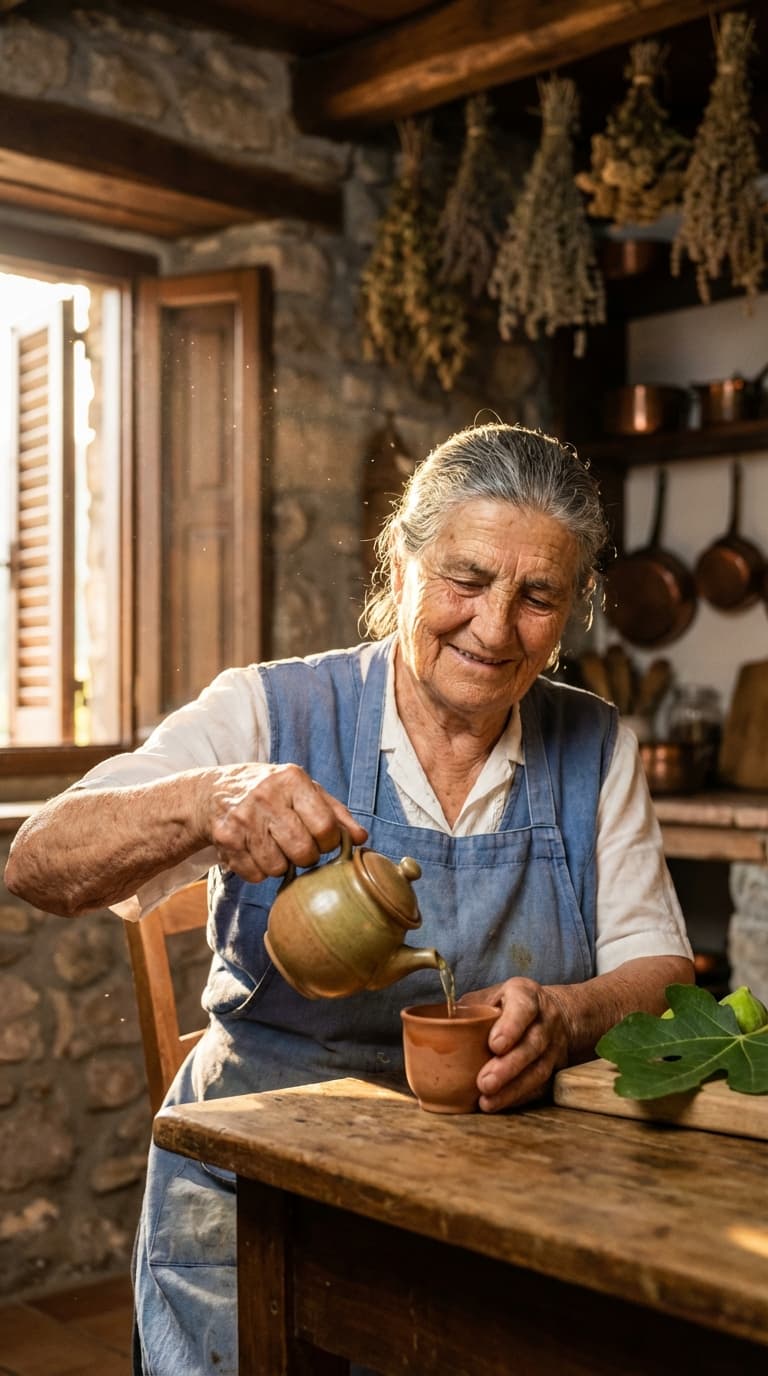
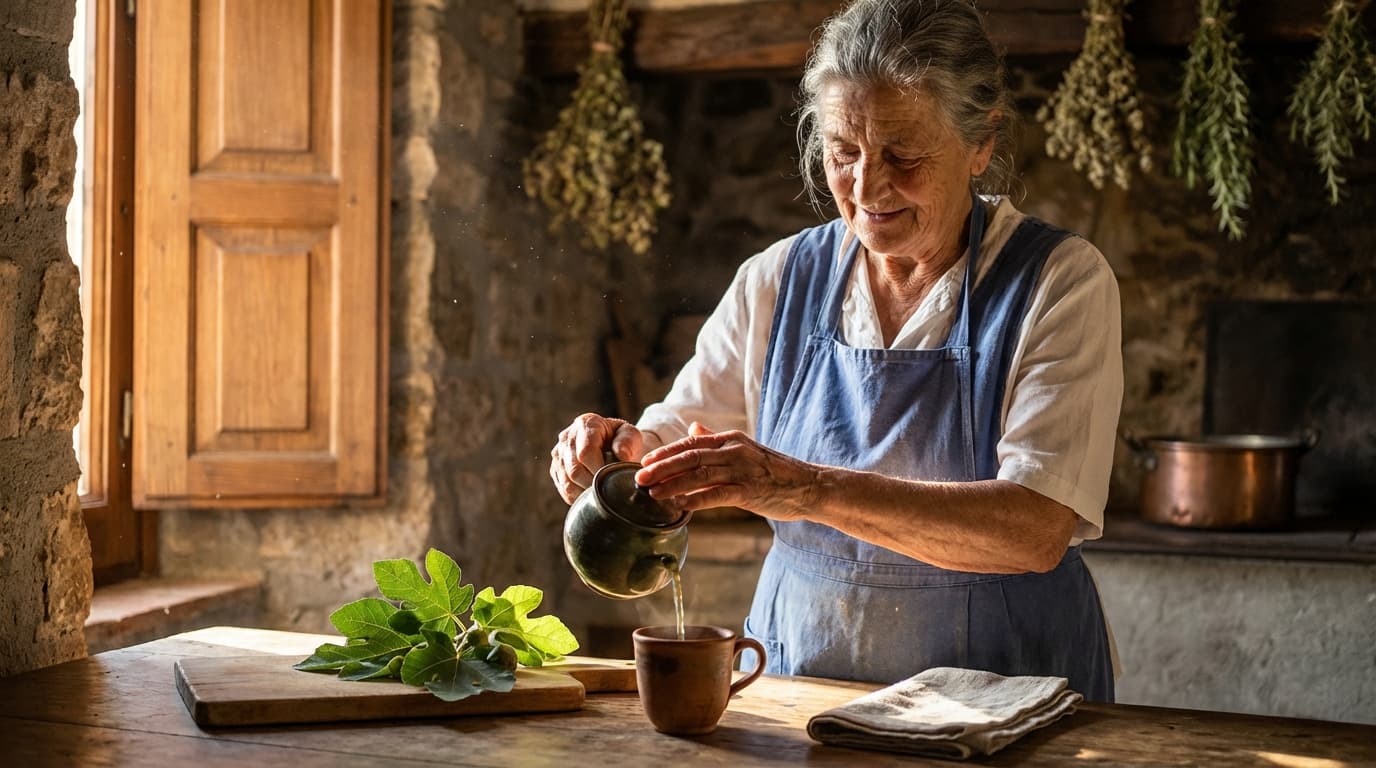
That afternoon, in the kitchen of an eighty-four-year-old woman named Maria Catarina, I watched a ritual that has been performed in the kitchens of southern Italy for at least four thousand years.
It took seven seconds. She picked two fresh fig leaves. She tore them. She dropped them into a small ceramic pot. She poured boiling water over the top. She covered it. She walked away. Six minutes later she came back, strained the leaves out, and handed me a small clay cup of pale tea.
The 1998 Clinical Trial Nobody Talks About
Here is the part the medical establishment does not want you to know.
This is not folklore. It is one of the most thoroughly documented natural therapies for blood sugar, liver function, and metabolic health in modern peer-reviewed literature. And almost no doctor in the United States has ever read the studies.
In 1998, a Spanish research team led by Dr. Antonia Serraclara at the Hospital Universitario Príncipe de Asturias in Madrid ran a small but rigorous crossover clinical trial on insulin-dependent diabetics. Their question: what happens if you give a patient a fig leaf decoction with breakfast every morning for a month?
The result was published in Diabetes Research and Clinical Practice (Volume 39, Issue 1, pages 19-22, PubMed ID 9597370).
In just one month of drinking the same humble fig leaf tea Maria had handed me, the patients' post-meal blood sugar dropped significantly and their insulin requirements fell by approximately 12%. No side effects. No interactions. No mystery.
The ABA Liver Switch
Fig leaves contain an unusually high concentration of a compound called abscisic acid, or ABA for short. ABA is what scientists call a phytohormone, and it is one of the few natural molecules on Earth that mimics insulin inside the human body.
Specifically, ABA activates a receptor pathway called LANCL2. When LANCL2 is activated, your muscle and fat cells open up to glucose without needing extra insulin to push it in.
Read that sentence again. It is worth slowing down for.
I started calling it, in my notes, The ABA Liver Switch. Because that, more than anything else, is what it is.
What Happened To My Mother
I came home from Italy on a Tuesday in May. By Friday, my mother and I had built her first morning ritual together at her kitchen table.
At day fourteen, she told me her morning swelling under her right ribs had gone away for the first time in three years. At day twenty-one, she stepped on the scale and was down four and a half pounds without changing anything she ate. At day forty-two, she walked the entire grocery store without sitting down on the bench by the deli counter.
At day ninety-one, she went back to the same hepatologist who had originally diagnosed her. He pulled up her bloodwork. He read it twice. He looked up over his reading glasses and said, "Eleanor, your ALT is normal. Your AST is normal. Your liver looks better than it has in years. Whatever you have been doing, keep doing it."
Real People, Real Results
The Leaf Code
I built The Leaf Code for one reason. I built it for the people who walked into my old clinic in Cleveland looking for help, and who walked out with a prescription that did not work and a future they did not deserve.
It is everything I learned in fourteen years of hospital hepatology, combined with everything I learned in eleven months traveling between Italy and the United States, condensed into a complete twenty-one-day at-home protocol you can begin in the next ten minutes from your own kitchen.
Eight digital guides in total. Total value: $197. For the people reading this article, I am releasing it for just $19.
That is not a typo. Nineteen dollars for everything. One time. No subscription. No bottles. No upsells you cannot refuse. You download it instantly. You start tomorrow morning.
If, for any reason at all, you do not see your waistband loosen and your morning energy come back inside the first sixty days, you send me one word, REFUND, and I will personally return every penny within twenty-four hours. You can keep all eight guides as my gift.
READER COMMENTS (1,247)

Robert F. · Dublin, Ireland ·
“My wife sent me this article. I was the skeptical one. Then I read the actual PubMed paper Mark cited. It is a real study. I just bought it.”
👍 198 ·